

This is a summary of the pitch presented at SPIN on April 15th.
Hi everyone, I’m Luke Frydenger from Manifest Space and we’re building the coordination layer for space.
The Problem
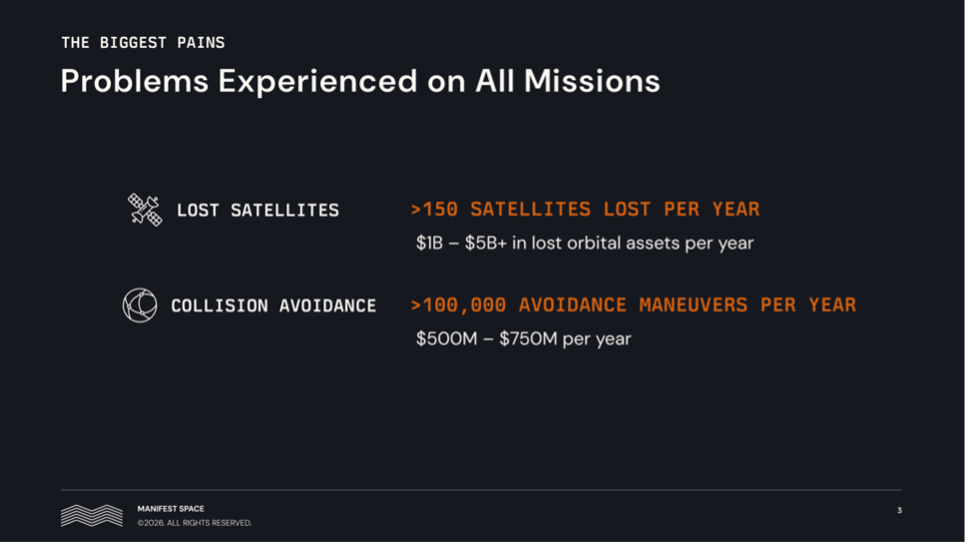
Space is becoming the next major mode of transportation, and it’s scaling fast. But the systems that keep it safe haven’t kept up. The problems are already serious: one in ten satellites that gets deployed never comes online or gets cataloged. For a small company, that could mean the end of their business. For a large operator, it’s a direct hit to the bottom line. And as more satellites crowd into orbit, collision avoidance is becoming a constant challenge. In just the first six months of 2024, SpaceX alone executed 50,000 maneuvers —each one costing fuel, time, and labor while pushing satellites into uncertain trajectories.
The Solution
This problem has been solved before in other industries. Maritime has AIS. Aviation has ADS-B. Both rely on transponders — compact devices that broadcast persistent identity and position, giving everyone around you visibility. Space doesn’t have that yet. Manifest Space is building exactly this: a transponder and coordination layer for satellites that gives operators shared awareness, safer traffic coordination, and the foundational infrastructure needed for the orbital economy to scale.
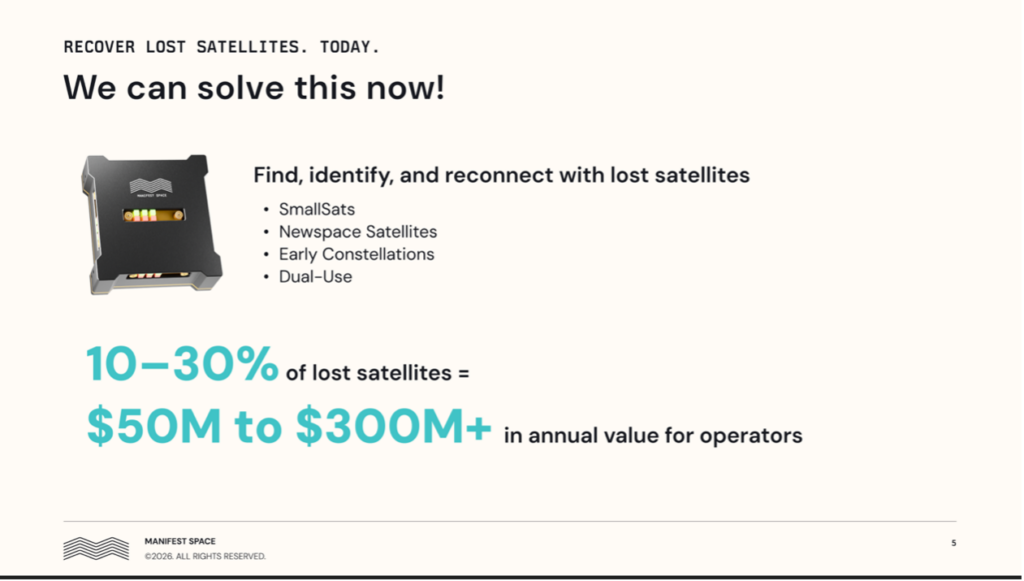
Our first target is the lost satellite problem. Our transponder allows operators to locate, identify, and troubleshoot satellites that fail to come online or experience anomalies during early operations, whether it’s a small sat, an early-stage constellation, or a new space company’s first mission. The cost savings and risk reduction for the industry are significant.
Beyond that, every transponder we deploy becomes a node in a growing orbital data network, increasing position certainty and enabling entirely new coordination, automation, and operational data services for satellite operators.
Traction & Competitive Edge
We’ve secured a flight with SpaceX for our first demo mission launching in October, where our optical beacon MVP will perform an on-orbit test with Kayhan Space and SpaceX’s Stargaze system to help close the satellite visibility gap for smaller objects in orbit.
Looking ahead, we are also actively engaging with policymakers and agencies across the U.S., Europe, Japan, and Australia, helping shape emerging standards for space traffic coordination. This work supports regulatory alignment and accelerates adoption of our system as coordination requirements evolve.
Thank you.
Want to Connect?
Luke Frydenger: https://www.linkedin.com/in/frydenger/
Manifest Space: https://www.manifest.space/