

Born from years working inside e-commerce operations, Milkyway X AI is turning fragmented retail data into clear decisions helping brands free cash, prevent stockouts and plan inventory with confidence.
For many apparel brands, inventory planning still lives in spreadsheets. Planning teams pull numbers from Shopify dashboards, ERP systems, warehouse software and purchase orders, stitching everything together manually before making a buying decision. By the time the analysis is complete, demand may already have shifted.
The result is a familiar pattern across the industry: best-selling items sell out too early, while slow-moving products quietly accumulate in warehouses.
Stockouts erase revenue at the exact moment customers are ready to buy. Overstocked inventory traps working capital for months. And often, brands only discover the damage after a weekly planning review – when the opportunity to fix it has already passed.
Milkyway X AI was built to close that gap.
The company’s platform connects fragmented commerce systems and continuously monitors demand signals, inventory positions and supply constraints. Instead of generating static dashboards, it translates data into clear planning actions – deciding what to buy, when to replenish and where to allocate inventory.
The platform has become a behind-the-scenes advantage for $10M+ apparel brands trying to stay ahead of stockouts and dead inventory.
From E-commerce Operator to AI Builder
The idea behind Milkyway X AI didn’t come from a research lab or a consulting study. It came from years spent inside the day-to-day operations of e-commerce brands.
Co-founder Farmon Akmalov began his career as a self-taught e-commerce developer. Over six years, he worked closely with dozens of direct-to-consumer brands, helping them build storefronts, automate fulfillment workflows and improve customer experience.
That operator-side exposure revealed something surprising: most inventory mistakes weren’t caused by poor data. They were caused by slow decision cycles.
“Forecasting and buying are execution problems, not reporting problems,” Akmalov says. “Brands often have the data they need, but it lives in spreadsheets and disconnected systems, so decisions happen too late.”
Before launching Milkyway X AI, Akmalov built Milkyway Delivery, a Shopify app focused on local delivery and returns. That experience gave him a deeper understanding of how fulfillment speed, returns and inventory placement directly affect profitability.
To transform those insights into a scalable technology platform, Akmalov partnered with Chirag Bhavsar, Milkyway’s co-founder and CTO.
Bhavsar brings more than a decade of experience building e-commerce software integrations across complex retail stacks – connecting storefronts, ERPs, warehouse systems, logistics platforms and purchase order workflows.
That technical background proved critical in solving the messy data problems that define real-world retail infrastructure.
When a Pattern Becomes a Product
The origin of Milkyway X AI wasn’t a single “aha” moment. It was a pattern the founders could no longer ignore.
While working with more than 30 direct-to-consumer brands across apparel, beauty, fitness and consumer goods, they repeatedly saw the same cycle play out. Best-sellers would stock out during peak demand. Slow movers would quietly pile up.
Teams would only recognize the imbalance after a spreadsheet review.
The real problem, they realized, wasn’t missing analytics tools. It was the delay between signals and decisions. Planning systems were built for reporting – not execution.
Recent advances in machine learning and automation made a new approach possible: a system that continuously monitors signals and recommends actions in real time.
But first, the team had to solve one of retail technology’s most persistent problems – data fragmentation.
Inventory information lives across multiple systems: Shopify, ERPs, warehouse software, purchase order tools and spreadsheets acting as glue between them.
Milkyway X AI addressed this by building what the team calls a “truth layer.”
This data foundation standardizes product identifiers, reconciles inventory states across systems and validates data quality before any recommendations are generated.
“Agentic systems are only useful if the data is trustworthy,” Bhavsar explains. “Our truth layer resolves SKU identity, inventory states, and purchase order timing so the AI can make decisions that hold up in production.”
On top of that foundation, the company developed a multi-agent AI system that monitors performance, forecasts demand and converts insights into decision-ready planning actions.
Early traction came quickly. Within three months, Milkyway X AI had dozens of mid-market brands on its waitlist and multiple pilots underway.
Meet Gaia: The AI Inventory Planner
Milkyway X AI’s latest milestone is the launch of Gaia, an AI inventory planner designed specifically for mid-market apparel brands.
Released on March 1, Gaia represents the company’s first step toward building a broader AI planning workforce. Unlike traditional analytics tools, Gaia isn’t designed to generate charts or reports.
Instead, it behaves like a digital planner – continuously scanning inventory and transaction data to identify risks and opportunities before they become expensive mistakes.
The system focuses on three measurable outcomes:
- Overstock prevention: Detecting where demand is weaker than expected so brands avoid overbuying and free up working capital.
- Stockout recovery: Identifying products selling out too quickly and estimating lost revenue when inventory runs dry.
- Forecasting accuracy: Demonstrating prediction reliability so teams can trust the system’s recommendations.
In one anonymized pilot with a mid-market apparel brand generating more than $10 million in annual revenue, Gaia analyzed over 600 SKU variants across sizes and colors.
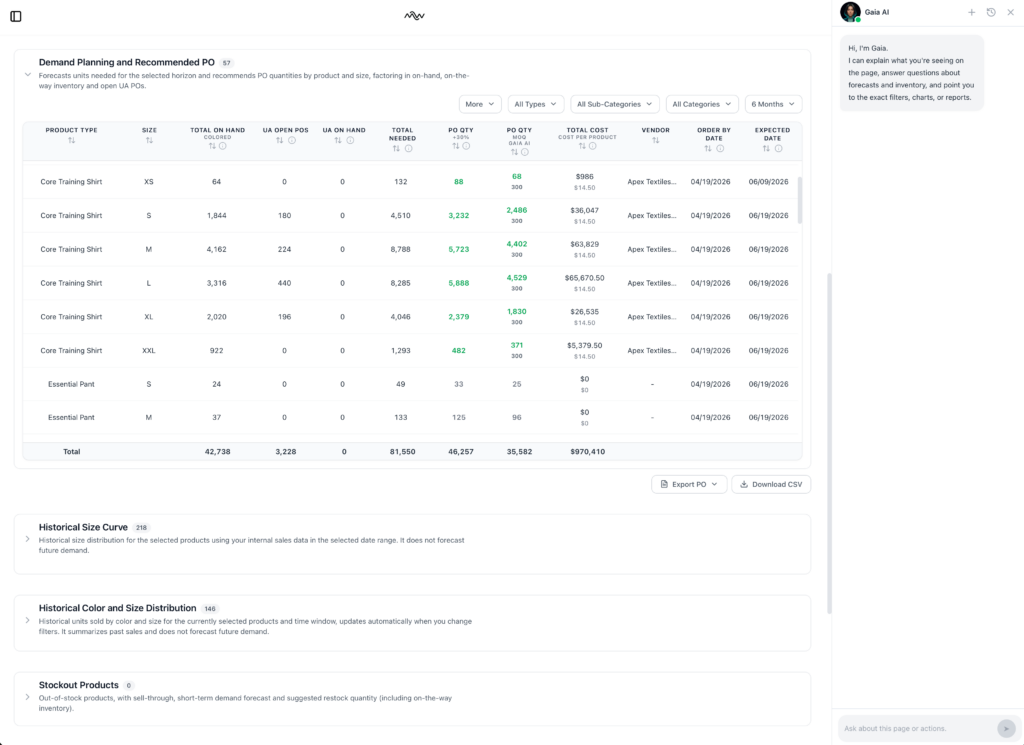
The results were striking. The system identified more than $300,000 in total financial value, including:
- $160,000+ in prevented overstock
- $170,000+ in sales opportunity from stockouts
- 80–90% forecasting accuracy on key revenue drivers
“Gaia doesn’t just predict demand,” Akmalov says. “It converts predictions into decisions that free cash and recover sales.”
The Elev X! Effect
As Milkyway X AI evolved from product concept to venture-backed startup, the team sought a program that could accelerate real-world adoption.
They found that support through NEC X’s Elev X! venture studio. Rather than focusing only on pitch preparation, Elev X! emphasizes operational execution – helping founders refine positioning, validate customer segments and build measurable success metrics.
For the Milkyway team, the program helped sharpen their ideal customer profile and product narrative for mid-market apparel brands. Mentors also provided practical feedback on integrations, pilot structure and enterprise readiness.
The result was faster pilot onboarding, clearer case-study outcomes and stronger go-to-market positioning.
“We chose Elev X! over other VC-style accelerators because it was structured around execution and measurable progress, providing direct access to operators and a network highly relevant to commerce, supply chain and applied AI,” said Akmalov.
The Future: AI Employees for Retail Planning
Akmalov and Bhavsar see Gaia as just the beginning. Their long-term vision is to build an AI planning workforce for apparel brand digital employees that continuously analyze operations and prepare execution-ready actions.
These AI systems could monitor inventory flows, generate replenishment plans, propose purchase orders and even suggest negotiation strategies with suppliers.
In parallel, Milkyway X AI is evaluating how emerging automated negotiation technologies — such as NEC’s advanced negotiation automation research — could become part of its long-term planning stack.
By integrating AI-assisted negotiation capabilities, the company aims to empower smaller brands to approach supplier purchasing and retail selling decisions with the same strategic sophistication traditionally reserved for large-scale operators.
Humans would remain in control, approving each action, but the time-consuming analytical work would happen automatically.
“The next unicorns in retail infrastructure won’t be dashboards,” Akmalov says. “They’ll be agentic workforces.”
Building a Smarter Apparel Industry
Milkyway X AI was born from a simple observation: the apparel industry wastes enormous resources when planning is slow, fragmented and reactive. Excess production leads to trapped inventory. Stockouts erase potential revenue. And planning teams spend countless hours reconciling data instead of acting on it.
By transforming disconnected retail data into clear decisions, Milkyway X AI aims to help brands run the same revenue with dramatically less inventory investment.
“Our benchmark is working capital,” Akmalov says. “When inventory turns improve from 2x to 4x, that’s not analytics – that’s cash back into the business.”
The founders’ ambitions are big: help eliminate avoidable apparel waste at scale while unlocking billions in working capital and margin for the brands that power modern commerce.
Learn more about Milkyway X AI here: https://milkywayx.ai/